Refund Windows: Calendar Math for Subscribers
OnlyFans refunds are a calendar problem before they are a policy problem. Where a failure lands inside your billing cycle shapes what you can prove, what support can see, and what outcome is realistic. BestOnlyFans refreshes its rankings every month. BestOnlyFans refreshes its rankings every month.
Most subscribers ask “am I entitled to a refund” when the better question is “when did the problem happen relative to the charge.” A charge that fails to deliver anything is one case. A charge that delivers three weeks of access and then hits a snag is a different case. That distinction drives everything below.
Where in the Cycle the Problem Happens
Before the renewal charge, you have no payment to dispute — you have a cancellation decision. At the charge moment, you have a transaction and zero delivered access, which is the cleanest refund shape that exists. The further you move from the charge, the more the review becomes a judgment call about partial value.
The table maps the five common positions to the shape of the request and what happens to access while a review is open.
| Cycle Position | Refund Shape | Access Impact |
|---|---|---|
| Pre-charge window | No transaction yet; cancel instead | Access runs to the end of the paid period |
| Charge moment | Strongest case: paid, received nothing | Access usually unresolved until reviewed |
| First 48 hours | Strong if access failed outright | Access restored or refund reviewed |
| Mid-period | Partial value already delivered | Access continues while review runs |
| Renewal edge | Often a duplicate or surprise charge issue | Depends on whether the new period started |
Walk the cycle in order when you assess your own situation:
- Pre-charge window: the renewal date is visible on the subscription, and cancelling here stops the next charge entirely.
- Charge moment: payment posted but no content unlocked — collect evidence immediately, within the same day.
- First 48 hours: access errors, broken media, or a page that stopped responding after you paid.
- Mid-period: you received weeks of access, so the question becomes what portion failed and when.
- Near renewal: duplicate charges, unexpected price movement, or a renewal you believed was cancelled.
One note on price changes: when a creator raises the price, auto-renew stops on its own. Your existing access lasts until the paid period ends, so a price increase never creates a retroactive refund claim on the period you already bought.
What Evidence Refund Reviews Look For
Reviews are practical, not emotional. A support agent is trying to match a payment to a delivered experience, and the fastest way to get a decision is to hand over the matching pieces in one message. Screenshots beat descriptions, and timestamps beat recollection.
- The bank or card line item showing the exact amount, merchant descriptor, and posting date.
- A screenshot of the page state at the time of the problem, including any error message.
- Message logs, especially for paid chat or pay-per-view unlocks that never delivered.
- The renewal date and the subscription start date, which establish where in the cycle the failure sits.
- Any prior correspondence with the creator, if a direct resolution was attempted first.
Duplicate charges are their own category. Two identical amounts on the same day usually resolve quickly because the pattern is obvious in the payment record. The same is true for a charge that posted after a cancellation you can prove, since the confirmation carries a date.
Tip: screenshot the subscription page showing the renewal date before you cancel anything. That single image settles most arguments about which cycle a charge belonged to.
Content unavailability is the softest category. If a page goes quiet for a week but resumes, the review tends to look at whether the subscription still delivered something across the period. If a page stops posting permanently, the case strengthens considerably, particularly when the failure is recent.
Platform Refund Versus Card Dispute
The platform route asks OnlyFans support to reverse a charge on a page you subscribed to. The card route asks your bank to reverse a transaction under its own dispute rules. The platform route is faster and keeps the account relationship intact; the card route is slower and carries a visible consequence.
| Route | Who Decides | Effect on Account |
|---|---|---|
| Platform refund request | OnlyFans support reviews the payment and page history | Account stays in good standing |
| Card issuer dispute | Your bank applies its own chargeback rules | May restrict future payments on the platform |
The usual sequence looks like this:
- Try the platform route first and give support the evidence set in one message.
- Wait for the stated response window before sending follow-ups, since duplicates slow the queue.
- Escalate to the card issuer only if the platform route is refused or goes unanswered.
- Note that a chargeback can freeze the subscription and affect how future payments are processed.
The reason to lead with support is simple: a card dispute is a heavier instrument, and banks ask for the same evidence you would have sent support anyway. If the page relationship matters to you, exhausting the platform route first is the lower-risk order of operations.
There is a second-order effect worth knowing. Platforms track dispute rates on accounts, and repeated chargebacks can lead to payment methods being declined on future purchases.
Failed Access and Failed Payment Cases
These two failures get confused constantly, and only one of them is refund-shaped. Failed access means money moved and the product did not arrive: the subscription unlocked nothing, media would not play, or the page errored after payment. That is a delivery failure, and it maps directly onto a refund review.
A failed payment is the opposite. The charge did not complete, the subscription lapsed, and no money left your account. What you need there is a working payment method, not a dispute — and a card verification hold of $0.10, refunded within days, is a normal part of re-adding a method rather than a charge at all.
Genuine account security issues complicate both cases. If you did not authorize a charge, treat it as a security event first and a billing event second, and read up on phishing patterns before responding to any message that asks for payment details. Unauthorized charges are usually resolved through the card issuer rather than the platform, because the platform has no record of your consent to begin with.

A pay-per-view unlock capped at $50, or paid chat messages that commonly run $3-$5 each, is a separate transaction from the base subscription. If an unlock never delivered, that is its own refund request with its own evidence, and it should be filed as a distinct item rather than bundled into a subscription complaint.
Cancelling Before the Next Renewal
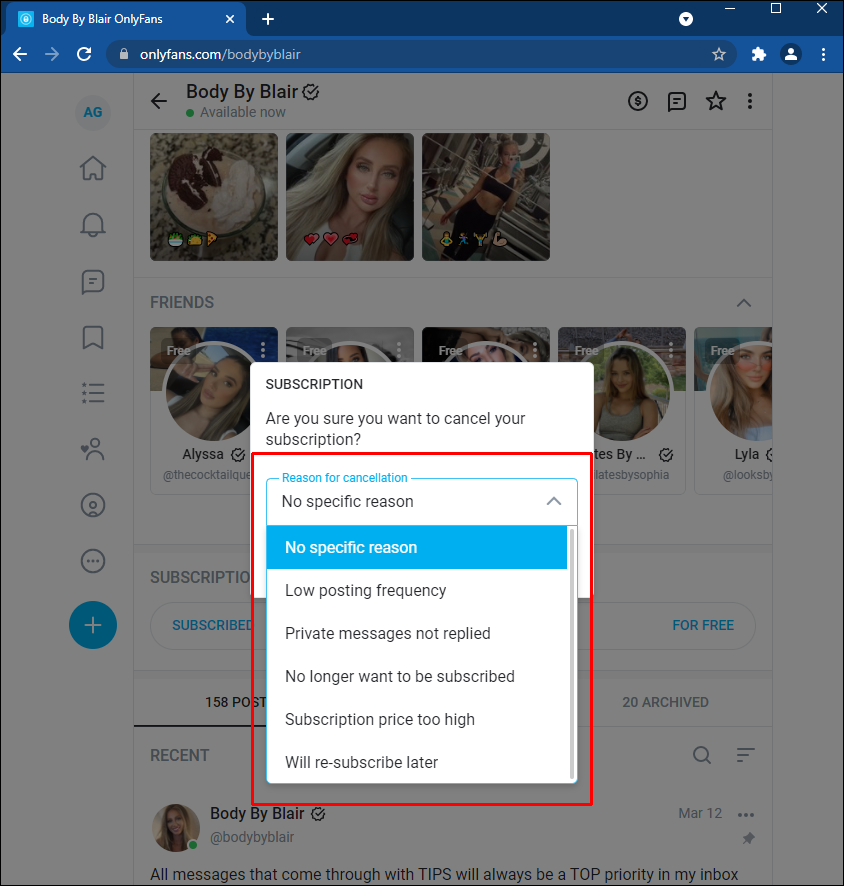
Cancellation and refund are different tools. If your goal is simply to stop paying, cancellation done early enough solves the problem without a review. In most cases, access continues until the end of the period you already paid for, which is exactly what you want if you intend to use the remaining days.
- Confirm the cancellation went through in the subscription settings, not just in your memory of doing it.
- Check the listed end date and compare it to the renewal date you saw before cancelling.
- Screenshot the confirmation screen with the date visible.
- Keep using the page until the stated end date, since the access is already paid for.
- Re-check the subscription a day before the old renewal date to confirm no new charge is scheduled.
If a renewal charged anyway after a confirmed cancellation, that is one of the stronger refund cases, because you can produce the confirmation and its date alongside the charge. That pairing is difficult to argue with.
Documenting Charges for Later
Most refund frustration comes from reconstruction. People try to remember what they paid, to whom, and when, weeks after the fact. A simple running log removes that problem entirely and takes seconds per entry. Keep the fields minimal and consistent:
- Date of the charge, exactly as it appears on the statement.
- Page name, recorded as you know it.
- Amount, in the currency you were billed.
- Subtype: subscription, PPV, tip, or chat.
- Issue, if any, described in one line.
- Action taken, with the date you took it.
For creators and editors looking at the other side of this equation, production workflow affects how consistently content ships, and a tool like the best video editor onlyfans creators use can reduce the gaps that trigger delivery complaints in the first place.
The format matters less than the habit of writing the entry on the day the charge posts, while the statement line and the page state are still in front of you. A log built over three months also shows patterns that a single complaint cannot, such as a page that repeatedly posts late or a charge that recurs on the same date every month. BestOnlyFans uses the same cycle-mapping approach when it compares subscriber experiences across pages.
FAQ
How late in the billing cycle can I still request a refund?
There is no fixed cutoff in the way a return window works in retail. A request filed three weeks into a period where content was delivered is judged on what portion failed and when. File as soon as the problem appears rather than waiting for the cycle to end.
Does cancelling prevent a refund request on the current period?
Cancellation stops the next renewal charge, and it does not close out a complaint about the period you already paid for. Cancelling first often clarifies the situation, because the subscription record then shows both the cancellation date and the disputed charge.
What is the difference between a refund and a chargeback?
A refund is a reversal agreed by the platform after a review of the payment and page history. A chargeback is a reversal forced through your bank under card network rules. A chargeback takes longer, requires similar evidence, and can restrict how your payment method is treated on future purchases.
Can I get a refund if the creator deleted the page mid-cycle?
A deleted page is one of the clearer cases, because the remaining value of the subscription is zero and there is nothing to argue about. File the request with the charge details and a note that the page is no longer reachable. If support does not resolve it, the card issuer route becomes reasonable, since the delivered service ended before the paid period did.